Sunday, March 10, 2019

Rant: Futuristic Criminology

About two decades ago, I was studying criminology.  In between mind numbing memorizations of theories of crime and society, brutally scientific study of both qualitative methodology and complex adaptive systems theory, and the academic grunt work expected of apprentices in a rigged system, I had time to do some thinking.

I see that the last of my predictions came true today.  The local rag, the Murky, reported that local police are starting to use predictive software to target patrols and other police activity.

Herewith, the list, from _1995_:

  • Cameras required on both police vehicles and on the bodies of police officers.  

  • Gunfire detection systems using acoustics in both fixed mounts and on police vehicles.

  • The use of software to allocate police activity to avoid accusations of discrimination.

  • The increasing militarization of police resulting in the widespread, routine adoption of military weapons and tactics including select fire weapons and excessive use of force against suspects.

  • The routine electronic fingerprinting of all suspects.  The gathering of DNA from all felony suspects.

  • Police aircraft equipped with weapons systems for stopping suspect vehicles.

If I stretch a point (the Coast Guard being part of DHS and thus a police agency), all six have come true in spades.

You get no points for being right too soon.  There is bittersweet satisfaction in knowing that my C- paper is a retroactive A.

But I have to live in the society thus made.  And, so do you.  Enjoy.

Appropriate Technology - POTS (Plain Old Telephone Service)

I grew up in the 1980s.

I remember when I saw my first mobile phone.  It was the size of a large purse, weighed several pounds, had a battery pack itself the size of a modern tablet, and large light up keys.  It cost over two thousand dollars and service was priced per minute.

When I first had 24/7 management responsbilities, I used a numeric pager.  Later I forwarded E-mail to an alphanumeric pager.  I had my flirtations with the first generation Blackberry and with Pacific Bell Mobile, the first PCS cell phones.

But there is one telecommunications technology that predates them all, and is still very valuable today.

POTS = Plain Old Telephone Service.  Copper line.  

Advantages:

- works without power

- easy to troubleshoot

- transmits your physical address correctly when you call 911

- only service that guarantees Reverse 911 functionality, i.e. you don't have to sign up to get Reverse 911 calls, you just get them

- less likely to overload during major events or disasters

- ease of use for those born before 1990

Disadvantages:

- no messaging

- caller ID requires a powered phone and/or a separate device

- "STAR codes" are needed to either allow caller ID to go out *82 or block them *67

- relatively expensive compared to VOIP or mobile phones

- billing information is tied to physical address of installation

One esoteric detail of POTS is what we call the REN, or Ring Equivalence Number.  The wired phones draw power from the line itself, which can cause quality issues if you have too many phones plugged in.

I like cordless phones.  But they rely on power.

If you still have a POTS line, make sure you have an ordinary wired phone plugged in, and test it every once in a while.

If you don't have a POTS line, and have decided to have VOIP or 'Internet Phone' instead, do your homework on how this interacts with 911, Reverse 911 (which you must now sign up for!) and how it works if you or your Internet provider lose power.

Sometimes Appropriate Technology is about what is simple and works.  POTS met this definition in the 1980s and still does today.


Friday, March 8, 2019

Appropriate Technology: The Dollar Store

My first paid job ever was in a discount retail store, a so called 'five and dime' where the five was a nickel.

Prices have gone up, and these stores are now called 'dollar stores.' Except for local variations such as Daiso (the $1.50 Japanese themed stores in the San Francisco Bay Area and Southern California), they price most items at $1 each. These include Dollar Tree and the $0.99 Cent Store, "open 9 days a week." [neat trick]

How is this an Appropriate Technology post? Because the mechanism by which these stores operate is itself a fascinating piece of tech, and understanding it can save many, many dollars.

Everything at the dollar store varies in actual price. That sounds strange when everything costs a dollar, but it is quite true. The difference is the _quantity_ not the numerics.

I comparison price shop constantly. This is a skill that should be taught as part of basic financial literacy in elementary school. Not high school. Elementary school. Because kids who know how to buy good food cheap get better nutrition, and all too many kids have to shop for their families.

Your local grocery store may have a pack of 100 tea bags for $3.99 when the big box store (Walget or Talmart, you figure it out) has the same product for $2.99. The dollar store has 20 tea bags for $1.

Price per each, the grocery store charges $0.04 per individual tea bag. The big box store charges $0.03 (and that 25% savings can add up.) The dollar store charges $0.05 and is actually the most expensive option of the bunch!

Unless you only need 20 tea bags. The ability to buy smaller quantities, titrated to what you need, is where the dollar store shines.

Note: an outlet store may sell you a thousand tea bags for $12.99 which sounds great. Break it down per each, and you are paying only $0.013 per bag. But will you drink a thousand cups of tea before the package goes bad, and do you have that much storage?

Unless you are deliberately stockpiling, or anticipate a major change in prices (always up), it is more efficient to buy what you need when you need it. This is especially true when it has an expiration date.

More about expiration dates soon. And also what retailers call "velocity."


Thursday, March 7, 2019

Rant: Mountains, Bad Drivers and Ugly Weather

I live in the Santa Cruz Mountains. "We don't drive on the left side of the road, we drive on what is left of the road."

It turns out that when you insist on installing a road net in earthquake country on the sides of steep hills prone to mudslides and collapses, then string that road net liberally with power and comm lines, with trees all over the place ... there tend to be problems. Who knew?

Now add the infamous California driver. This timid but aggressive beast believes he is an above average driver, has no idea where the true limits of their vehicle can be found, and cheerfully multitasks while drive the speed limit on a wet road in heavy rain. Add obliviousness to concepts such as hydroplaning, friction, rockfall and "a safe and prudent speed for the conditions." Now add being totally lost.

Fortunately, the Santa Cruz mountain resident is often equipped with a wide variety of tools to face this challenge.

  • community groups on Nextdoor and FaceBook with up to the minute road information, some of the latter secret
  • the numbers for CalTrans Road Conditions, County Roads, local CHP offices and one's elected public officials
  • a modest supply of basic mountain emergency equipment, such as a chainsaw, tow chains, shovels and rakes
  • a ready list of excuses to use with work for being late
  • a cellphone with camera to use as a dashcam and/or documentary proof of why one couldn't get down the hill, or had to drive alternate routes
  • traffic and emergency information apps such as Cruz511, CalTrans, Citizen Connect and PulsePoint
  • navigation apps such as Google Maps and Waze
  • last but not least, emergency caffeine, because the nearest Starbucks is not on the nearest corner
We're not road warriors. We're road barbarians.

Locals will get the multiple jokes embedded in this picture. "Valley go home."

Wednesday, March 6, 2019

Captain Marvel: A Spoiler Free Review


By special arrangement I have seen the latest chapter in the Marvel saga, Captain Marvel.

This review is spoiler free.

I find this a worthy addition to the series, neither the worst nor the best. The themes of empowerment are a little heavy handed, but it is the right time in the cultural zeitgeist to make these points.

The massive support for the movie by a certain government's military is blindingly obvious even well before the end credits.

Of course, one must take care to respect the kitty. Nick Furry fans will rejoice. (sic? or was that hic?)

Obviously stay for both cut scenes, as this is a Marvel movie.

There is a touch at the very beginning that die hard fans will greatly appreciate.

Keep those membership cards, folks, you never know when you might need to rent a video.

What is it with Marvel and security guards, anyway?

I thought the heel face turns were blindingly obvious from the previews. I was only partly correct.

Go with an open mind and enjoy.


Monday, March 4, 2019

Appropriate Technology: The Lowly Reusable Water Bottle (and Daiso)


Tonight's Appropriate Technology post is brought to you by the lowly water bottle.

I'm going to make two assumptions before we start: 1) your dependence on the Card survival option is not such that you just go around buying fresh disposable water bottles wherever you go, and 2) you're in an urban area, as getting water in rural settings (i.e. not from a municipal water system) is a whole different ballgame.

The recyclable plastic water bottle can be reused for a day or two, but is a pain to clean even with the right equipment, can absorb odors and should probably be discarded everyday or two.

A reusable water bottle can be reused indefinitely if cleaned properly. I personally find that scrubbing once a day and washing with soap and hot water once a week is more than adequate. Your mileage will vary. Your choice of materials will vary: various plastics, metal, glass, etc. (So an option if you need to be cheap is a glass bottle with a reusable lid, such as an iced coffee bottle.)

The chain stores will cheerfully sell you a water bottle for prices ranging from larcenous to outright obscene. But you can do better. Your town has a secondhand store, a thrift shop or a dollar store ... and any of these can provide a water bottle with any desired characteristics. You will want to wash your bottle in any case, from any source.

I will mention Daiso for those who are on the West Coast, but especially the San Francisco Bay Area. Daiso is a Japanese dollar store carrying Chinese products made and labeled for the Japanese market, at the standard cost of $1.50 each. Of course this includes water bottles. Daiso carries a very wide array of cleaning brushes for any bottle you care to name, and tiny brushes specifically for cleaning reusable straws.

I have found for myself that the lowly baby bottle brush is the best deal for cleaning water bottles at an American dollar store.

Either can sell you detergent if you need it.

The last step is to get frequent access to a tap to get drinking water, and less frequent access to a sink to wash your bottle.

The world is now full of soda machines. One variant of soda machine is a standing upright console with a touch screen that offers over a hundred different Coca Cola(TM) products. And also Water, labeled as such.

On more conventional soda machines, there is a small white lever, sometimes labeled sometimes not, that dispenses water. (Once in a while, there are two white levers. The other one dispenses unflavored soda water.)

I encourage caution when using restroom sinks to wash and fill bottles. This is a common cause of cross contamination, unfortunately with fecal matter. Wash the faucet and the handles, wash your hands, wash the brush, wash the bottle with hot water, rinse the bottle with cold, wash the brush and put it away. Wash your hands again. Then if you can, find somewhere else to fill the bottle. If you can't, do what you need to do. If you pay attention to where you put your hands and bottle and brush, it's perfectly safe.

The corporate world is full of break rooms, where sinks and water filters and water dispensers and microwaves abound. If you have a cold water tap, a microwave, and a microwave safe container such as a ceramic mug or small microwave safe plastic bowl or cup, you have hot water shortly.

The lowly gas station and convenience store often have a small hand sink in the customer area. Be discreet and buy something, but that's an option in an unfamiliar area.

Santa Clara County, in a rare rush of brains to the head, is encouraging the public installation of not just drinking fountains but water bottle fillers. These hybrid machines are most commonly found in gyms, but in Santa Clara County are becoming standard in public buildings such as government offices and libraries, but can also be found in many public parks.

There is a next to last resort: to buy water from a vending machine. Note that they sell water in 1 gallon increments, sometimes for coins, sometimes for dollar bills, and occasionally in a grocery store with any payment method the register accepts. I'd suggest buying a disposable 1 gallon water bottle and refilling that as needed, for less than a week or so.

I won't get into survival situations, except to point out that recycled water (usually labeled as such), water that has sat in garden hoses, and such should not be trusted for drinking. Also, the use of needlenose pliers or a faucet wrench to open a locked water hydrant can be considered theft, and is properly considered as a survival strategy when the choice is between that and literal dehydration.

I hope these tips and tricks are useful. Do you have any you'd like to share?

Sunday, March 3, 2019

Appropriate Technology - Go Bags, EDC & Cards

Appropriate Technology - Go Bags, EDC & Cards

Definitions first. A "go bag" is something you carry that contains what you need to survive. EDC is an acronym for Every Day Carry, or what people carry on their person or in their pockets to get through daily life. Card: one of the most used, and least thought about, possessions of modern life is the lowly card, whether credit or debit. Until you misplace one.

All three are solutions to one of life's most basic problems - how do you keep yourself warm, dry, watered, fed and in reasonable health while going where you need to go and what you need to do.

The Go Bag is this concept to an extreme, carry all the stuff you need because you might need it suddenly. A money card is the exact opposite: the world is full of waterproof ponchos, toothbrushes, bottles of water and tasty meals, you just have to find a pile of them next to a cash register and help yourself. Every Day Carry is somewhere in the middle ... those things you choose to carry with you, useful enough to not be disposable.

All three strategies have their merits. The goal here is to start thinking about what you carry, what skills you have, what ability you have to access goods and services, etc.

Note that I haven't talked (yet) about disasters, natural or otherwise. That changes things. If you can't find anyone to take your card or cash, that's not a good approach. If desperate people help themselves to your Go Bag, or a mugger relieves you of the contents of your pockets, that $40 you tucked in a sock might get you out of a jam.

I've used all three approaches, in my home town and on the other side of the country.

My suggestion is merely that people think more about not merely what they put in their Go Bags, carry in their pockets, or are ready to buy with their credit cards from the gas station -- but also think about being ready to shift strategies if your card is stolen, you leave your jacket at the restaurant, or your Go Bag suffers sudden integrity failure and dumps its contents on a busy sidewalk.

Flexibility trumps preparedness sometimes.

Appropriate Technology - Appropriate Technology


Someone asked me, "Hey, I saw your post on Appropriate Technology. What's Appropriate Technology?"

Good question, glad you asked.

Sometimes I forget that I know things that not everyone knows. Appropriate technology is one of those things.

Let's break this down. Yes, I am a big believer in the dictionary. That rant will be in a minute.

"Appropriate," especially suitable or compatible.

"Technology," a capability given by the practical application of knowledge.

Appropriate Technology is using the right tool for the right situation in the right way.

There is an engineer's joke:

- Measure With Calipers (a very precise measuring tool)
- Mark With Chalk (a less precise marking device)
- Cut With An Axe (a much less precise cutting tool)

This is the opposite of appropriate.

In particular, in Social Ecology, the idea of Appropriate Technology is using exactly that technology suitable for the purpose, no more and no less.

In the early history of spaceflight, astronauts and cosmonauts needed to use some sort of tool to make marks in space. An ordinary pen simply wouldn't work.

NASA commissioned a pressurized ink cartridge pen that would flow smoothly in any conditions, including microgravity, and these 'Fisher Space Pens' made their inventor a small fortune.

Russia used pencils. But the small bits of graphite that break off when you use a pencil collect in microgravity, and can get into electronic circuits - and in a worst case, start a fire, which on a spacecraft is generally not survivable.

Both are examples of Appropriate Technology.

First it has to work. If it doesn't work, it's not appropriate.

Then it has to be elegant. In engineering terms, something elegant is simple, efficient and beautiful. Think of a stainless steel sink.

The opposite of elegance is - despite their advertising - anything to do with an internal combustion engine automobile, especially one of German manufacture.

The car is a great example of a Rube Goldberg gadget in which flaws are disguised by systems to address those flaws, and then systems on top of systems, creating a level of nightmarish complexity around which entire industries necessarily revolve. (There may be a panel about this at Baycon...)

The one saving grace of a car is that it works, that it gets you from point A to point B.

Recently a Tesla electric car collided with a Lime electric scooter. The comment in our local rag, the Murky, was "The most Silicon Valley thing ever!"

Both are examples of Appropriate Technology. An electric car is very simple. (The batteries are not... and therein lies a tale, but not right now.) An electric scooter is even more simple - if the rider wears a helmet.

So when I post about Appropriate Technology, I will post about a way of solving a problem that I think is particularly suitable.

Ecology matters too. Why wash your clothes with a bucket when there are washers in the world?

A clothes washer needs to be supplied with power and hot water. The hot water needs to be supplied by a water heater. These systems spiral up in complexity and scalability. A gas 'flash' hot water heater is a simple gadget, but the production and distribution system to bring propane to your home is impressively monstrous, and the underground pipeline system that brings 'natural gas' (what a marketing triumph to call it that) even more so. Just ask anyone who had to file an insurance claim for a cooked home in San Bruno.

The computer I type this on is itself a marvel of the modern world. Made overseas, shipped to America, parts sourced from all of the world, ultimately to be shipped back overseas and torn apart by scrappers for its little bits of gold and add a little toxicity to China. Plugged into a network of fearsome complexity, hosted on servers that ravenously turn power into waste heat (and require more power for AC cooling) ... you get the idea.

Perhaps I should be writing this blog with a Fisher Space Pen. Or even a pencil.

But then, who would read it? And that would fail the first test. It has to work to be appropriate.


Saturday, March 2, 2019

Rant: Techies, Free Work & Boundaries


Every now and then, I will indulge myself and my readers with a RANT.

Our friends at Webster define a "rant" as:

1 : to talk in a noisy, excited, or declamatory manner
2 : to scold vehemently

Ranting may include profanity.

Here's my rant about technology people who don't know boundaries.

I use technology and I've studied formally the sociology of technology. I've done tech support. I occasionally get to apply XKCD's infamous approach to technology problem solving, the Tech Support Cheat Sheet.

But I've never had the delusion that all the technology in the world is mine.

I am very reluctant to allow other people to work on my tech stuff, at a level that approaches paranoia.

Because they break it.

Example 1: when I was away at college, I configured an old computer to serve as a E-mail tool for my not-at-all computer literate mother to communicate with me. We painstakingly walked her through how to use Eudora Lite, and she got pretty good with it.

A guy named Max, a friend of my mother's and self proclaimed amateur radio expert, nuked and paved the hard drive to install his own 'free' software from a company called Juno, because this was a 'better' E-mail tool. In his opinion. Never mind the E-mails that had already been sent and received; they had no value to him and were lost.

I couldn't get home for two months to fix it. Meanwhile, my mother had completely lost interest in computers.

She never sent another E-mail again.

The computer had no further value to me. I had set it up for the purpose of being able to E-mail back and forth with my mom.

Max still acted like he'd done me a favor for over a year. He even suggested at one point that I should pay him for his work. It took me telling him to go fuck himself, in front of witnesses, for him to understand that he and I were not on speaking terms.

When my mother passed, he was not invited to her funeral. I'm told that only then did he realize exactly how badly I felt that he'd fucked up. I didn't speak to him again, so I have to take their word for it.

That was when I started using passwords religiously even on computers that never left my control. Just in case.

That was also when I totally lost interest in amateur radio. If Max liked it, it must be shit, and that was good enough for me. It would be another twenty years before I went back to amateur radio.

Example 2: when I was helping a friend with a difficult situation, it proved to be convenient to live for a couple of months in her rented house while she fought to regain control of the two houses she owned. (She won one, she lost one, but it's amazing how quickly people stop harassing an elderly woman when her not-elderly friend answers the door with a handgun.)

I took advantage of the extra space to sort through and prune through some of the tech I owned. One of these pieces of tech was an ancient Dell desktop that had been configured with a Windows 2000 installation.

Another friend was staying with me. I will not name him because I'd like to stay friends. But while I was working two jobs, he discovered a need to use the Dell desktop for Web surfing.

So he installed not only Linux but a whole hard drive encryption program on the desktop.

I recently got out this desktop to set it up.

Password? ...

After a couple hours, I called him. He gave me a password. It didn't work.

"Just use a USB key to reformat the drive," he suggested.

The me of twenty years ago would have told him where to stick the key and in what orientation.

Instead, I asked him to walk me through how to put Windows 2000 back on the desktop.

He started working the problem. "OK, you need to download a CD, you need a key, you need a USB boot key, you need a boot loader ..."

"How long is this going to take?"

"Several hours ... probably not worth it, you should recycle the desktop and start over with another device."

"..."

That's when he got it. He had taken a working piece of equipment and made it into a doorstop. It now has a sticky note on it, "XXXX broke me." I plan to give it to him when I see him next.

I have many other examples, pretty much at a one for one of "Did I allow X to touch my tech gear?" "Shit."

A friend of mine tells a story about a bear and a hunter.

"You're not here for the hunting, are you?" the bear asks at the end.

Doing the same thing and expecting a different result is one definition of insanity.

So I have to take some of the blame myself.

Tech support for free is worth rather less than what you paid for it.


Friday, March 1, 2019

Appropriate Technology: Bucket Laundry

Appropriate Technology: Bucket Laundry On one of the many off the grid groups I follow, there is a hot discussion of a spinning clothes washing gadget. It's basically an egg on a swivel mount with a closing lid and a hand crank. You put your 2-3 pounds of laundry into the egg, add a little detergent and some water, and spin. All this for the low low price of ... [redacted] Gadgets have their uses. Personally, I would rather buy time on someone else's washer and dryer. Coin operated laundries are right up there with sliced bread, cell phones and lubricant. (Kindly not in combination, please, although I have seen 'cell phone sandwiches' trying to get through a security checkpoint.) The even cheaper alternative is the lowly five gallon bucket. If you are so dirt poor that even $3 at Walmart or a $2 donation to your nearest Firehouse Subs is out of the question, a kitty litter bucket can often be found in apartment complex dumpsters. Make sure you get lids. At WalMart or your local dollar store, obtain a clean toilet plunger that has never been used, an important detail. Cut a hole in a lid just smaller than the diameter of the plunger handle. You now have a laundry bucket with built in agitator. Another alternative is to get a Gamma Seal type screw-on lid, typically under $10 at a big box hardware store such as Home Depot and _Low Es_teem (which I avoid shopping at after they crashed and burned Orchard Supply Hardware). These lids make any bucket into a air tight, water tight, almost rodent proof (*) enclosure. Either way, put your clothes _loosely_ into the bucket with warm or cold water and a little detergent. Either plunge the handle or put the sealed bucket in a vehicle. Two words about detergent: 1) Use very little, about one third what you would use on a small load of clothes, if not less. Be wary of the new concentrated detergents. 2) If you plan to pour it out anywhere but down a drain leading to a sewer or septic system, please choose a biodegradable detergent. I am fond of Dr. Bronner's myself. I leave rinsing (add more water) and drying (clothespins and line) to the reader.

Thursday, February 28, 2019

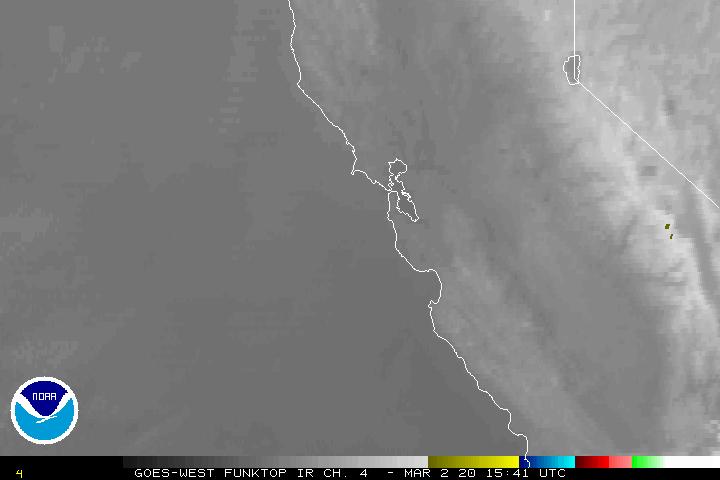
Appropriate Technology - A Weather Map That Updates To Your Android Phone

I have a bit of an unusual background. I spent some of my formative years on a small boat. Think Gilligan's Island with a less competent captain and crew.

Along the way, I learned a lot of weird skills. I can tie up a boat, fight a shipboard fire, launch flares, inflate a Zodiac and a lifeboat, use a VHF radiotelephone, etc.

But what I really learned is the power of the weather. On a small boat, waves bigger than your boat is scary. Fish bigger than you are scarier even when they don't have vertical fins. (Cue "Baby Shark" thirty years too early.)

Now that I live in actual rain forest, when it is not flaming, I found a need to stop having the weather interpreted for me by the well meaning local AM radio station, weather.com, various weather services, or even our friends at the National Weather Service.

I wanted actual weather radar images I could interpret myself.

But I didn't want to have to click on links every time. I wanted the image files _right there_

Fortunately, your taxpayer dollars pay for these radar images, and they are at static URLs.

Now I needed a tool that could put them on my Android phone. I found one, showr. The paid version is long gone, but the freeware version still has a valid apk floating around.

https://www.ssd.noaa.gov/goes/west/wfo/mtr/ft.jpg

https://radar.weather.gov/lite/N0R/MUX_loop.gif

If you live in or near the USA and you want to borrow this trick, go through these sites for the images most appropriate to your area.

Other weather tools are legion. There is one that sends text messages to satellite communicators. There are many others that allow you to collect weather data at home. Sensors abound in the San Francisco Bay Area. Example: https://www.wunderground.com/personal-weather-station/dashboard?ID=KCALOSGA226

This particular tool is invaluable to me, because the images are downloaded to my phone and stay available even when I am out of coverage range.

Technology is awesome. Unless the Pakistani and the Indians choose to throw some at each other. Then I get to write an article on trans-Pacific fallout and the weather becomes deadlier than ever.

Monetization - Value For My Words

Monetization - Value For My Words

It is 2019 and I sense that I am very late to this particular game, but I decided to click on AdSense and see what would happen. A little research told me to add a Contacts form, a Privacy Policy (mostly that I don't want to know and won't use data collected on who is reading), and some improvements to layout.

To be clear, this blog is intended for my non-fiction and political thoughts that are too unwieldy for Twitter or FaceBook, but that I feel that I should preserve.

I hope that others have an interest in reading them, but I've made no particular effort to market them either.

Yet.

I will be attending BayCon this year and expect to be on some panels.

Playing with ideas has been a hobby of mine for well over half my life.

Any feedback is welcome.

Meanwhile, I'm promise that I'll keep blogging and that what I blog will be 1) non fiction and 2) eclectic. I think that's only fair.

On Complexity - A (non-fictional) Rant

On Complexity - A (non-fictional) Rant

[First published Aug. 13th, 2015 06:14 pm ]

drewkitty: (Default) [personal profile] drewkitty

Had a long talk with Jonathan (*) yesterday while helping a friend getting her stuff moved out of storage. For an actor and would-be gamer who needs to take showers more often, he betrayed an astonishingly good grasp of security issues. Then again, perhaps he was just good at hasty memorization. In any case he was clearly 'on the job.' No idea for who.

It now occurs to me for several reasons that it might be healthy for me to lay on the line, as it were, some core beliefs. Better yet that I do so in a format that does not permit for redaction, shading of the truth, or reasonably honest misunderstanding.

“Politics is war by other means” and vice versa, ad nauseum. I hold degrees in political science and social ecology**; along the way I advanced to candidacy for a doctorate in criminology. So I might have done more than the average share of thinking on these subjects. I am also conversant enough with philosophy, at the annoying layperson level, to keep up with degree seekers in the field. (There is a reason why any Ph.D. is actually a philosophy degree first.)

The nation-state is at its heart somewhere between a public monopoly and a social contract, a “commonwealth” or better yet, “common wealth.” Regardless of the flavor of political system, the nation is a set of agreements. The United States makes it explicit that these agreements are “of the People, for the People and by the People.” The Constitution is therefore a social contract, a deal in which a lot of people gave up pieces of what they wanted in exchange for protections they felt they needed that badly. There is nothing terribly holy about the Constitution – but there is about the human and natural rights which the Constitution imperfectly attempts to protect.

The history of America is a history of changes of government within a loose framework. This broke down totally once – the Civil War – and has been tested any number of times. Whether we have a communist economy (World War II War Production Board), a cult of personality (Kennedy) or any other particular form of government, the system is loose enough that we get to change our minds every four to eight years, without too much fuss and piles of bodies in the streets. At the moment, political power trades hands between the left and right wings of the Republi-Crat (or perhaps Demo-rican) Party, with relatively little change within a narrow range.

In social ecology, I spent a lot of time battering my head against the implications of complex adaptive systems theory (you might call it “chaos theory”); non-linear differential equations and the implications of graphing them in two, three and four dimensions; and practical applications, including the opportunity to interview high ranking political, economic, corporate and social leaders.

I can say this in a sentence, but it may take me several paragraphs to explain. Technological advancement has overrun humanity's capability to manage complexity; however, the rate of change in human complexity continues to increase, posing grave risks of technological and/or social catastrophe.

Certain systems and processes are so complex that the best techniques we have to manage them are not quite good enough. Think of carrier aviation as a great example. The Russians and Chinese have attempted to field carriers. They have not yet been successful and for cultural reasons, it is perhaps possible that ultimately they can't do it – that the qualities needed for successful 'systemology' are beyond the commitments their governments are able to make. Meanwhile, the US Navy is about to make the next great leap in carrier aviation by taking pilots out of the cockpit and having autonomous takeoffs and landings of strike aircraft.

Spaceflight is another such complex process. Nuclear power is another. The modern 21st century hospital is on the verge – especially in trauma medicine and the intensive care unit. Mistakes in these processes kill. Just ask NASA (“Need Another Seven Astronauts”) or Japan's nuclear agency (“Fukushima.”) Medical errors kill more people in the US every year than firearms. The mistakes are largely because human beings, even in large numbers using various tools and methods to error-check each other, make mistakes from time to time and when the technology is sufficiently complex, the results can be and are deadly.

Then again, it was commonly believed that writing a computer operating system and writing an encyclopedia were so complex that it would take a skilled team some years to do so. This is true – yet we have Linux and Wikipedia – very complex human ventures managed by teams of very smart volunteers, using complex systems to manage the contributions of their participants.

With the advent of 3D printers, the last vestiges of Marx can be safely swept away. For $1000 I can go down to Home Depot and buy myself the means of production, thank you very much. I can rent time on much more sophisticated equipment. I have thought about writing a story about a distributed spaceflight program. I think the Mars Society may have beat me to it, just for real.

We have political debates about access to firearms. What will happen when every man is a nuclear power, and every home contains weapons of mass destruction? I've mused about this in the Itty Bitty Bigger Earth fiction (where this rant was posted), and will continue to do so. But the practical implications concern anyone who has thought about it. Never mind Soviet Georgia, what will happen when the state of Georgia gets the Bomb? Or three giggling lunatics with a farm in the boonies?

The tools of memetic and cultural warfare are out of the lab, beyond Madison Avenue, and out in the field. Saul Alinksy has not lived in vain – I would call him a “culture jammer,” someone who breaks the tools and the scenery to get what he wants, and has taught others to do the same. Fox News thrives on this kind of socio-dislocation. So do cheap glossy magazines like “Weekly World News,” except that they follow other people's trends instead of making their own.

Albert Einstein once said (paraphrased) that “Humanity is in crisis because political science is harder than nuclear physics.” He is now more right than ever. There is more and more raw power accessible to humanity (cf Al Gore's presentation, “This was a shovel (picture of shovel) and this is a shovel (picture of tracked steam shovel, taller than a highway bridge).” We are starting to move past the Information Age and into something new. Perhaps the Singularity, perhaps just a man running faster and faster down a steepening slope until his feet lose traction and he face plants. Hopefully not.

When I am asked, with over a decade of private security experience, about the subject of terrorism, I find it hard to give a short answer. I am a trainer with respect to counter terrorism, weapons of mass destruction, emergency response, the surveillance game, B-NICE or WTMD or CBRNE or whatever acronym of the week you prefer, and so on. I could tell you how to build a WMD with a $10 from the shelves of a 7-11 – but I won't.

Terrorism is the use of force by clandestine agents or a subnational group to achieve political change. (Right out of the FBI definition). For a variety of reasons, terrorism is horribly unethical. People who engage in terrorism are not merely criminals – who break the social contract for personal gain – but set themselves up in active opposition to the rest of society. The atrocities a terrorist commits are without any authority – any integrity – or any real justification. Terrorism is a symptom of serious social problems. Consider a peaceful society in which a crazed man commits an atrocity. The victims are comforted, the madman is made harmless, and life goes on. Justice takes the form of “comforting the afflicted,” understanding that both attackers and victims need help. Consider the opposite extreme – a society in which a significant minority of members praise the attack and the attacker – cheering when they hear of it. Clearly this society has some issues, not least of which is the incipient civil war implied by the presence of large numbers of terrorism supporters.

At present America is somewhere in the middle. We've always had a self-reliant streak, sympathy for the rebel, and a tendency to praise people who take solutions into their own hands. On 11 September, mainstream America figured out that we have global enemies who really would do us a lot of harm, given half a chance. We massively over-reacted, and thereby vastly increased the number, the intensity and the resources of those who would do us harm. (Fortunately, al Queda is too busy hating America and its own xenophobia and racism to realize how much traction it would gain by allying with domestic Black Muslims.)

We recently had a terrorist attack where a single lunatic openly attacked first a recruiting station, then a military base. He was stopped. However, the popular reaction was amazement that soldiers are not permitted arms to defend themselves. The base commander and at least one other, a Marine, were armed – in violation of procedures - and acted to protect their charges.

Another sign that America has a problem is that – spontaneously – Americans decided to take it upon themselves to go to their recruiting stations and protect them, standing outside armed. Some of these folks were veterans – some were not – and they lacked adequate training and in some cases tact – but they were willing to put their lives on the line to protect _their_ soldiers. Note emphasis. The military decided to treat this as suspicious, asked people not to do this, and asked recruiting stations to report this activity as potential terrorist activity.

The Americans who went down to the recruiting stations did so out of distrust – distrust that the Powers That Be would protect their recruiters and other soldiers. The military reaction – confronted with allies of dubious reliability (but far better than that of say, Iraqi translators) – to reject their help and treat them as suspicious, was even more distrustful.

This is a symptom, socially speaking, worse than car bombs. If The People and The Military cannot trust each other – and groups such as the 3%ers are openly recruiting within the latter – we got troubles.

My own reaction to America's relatively new – and a few rebrands like FBI -- state security agencies is somewhere between disgust, disdain and fear. Disgust because I don't think America needs its own KGB (or DHS as the case may be), and it's quite contrary to our traditional freedoms. Disdain because the competence level is so low, and I say this wearing my professional hat. If this is the best the Republic can do to protect itself, I weep for the Republic. Fear because innocence is not always a defense and I don't want to be made an example of. We still have rights, but proving it may someday be expensive.

My reaction to terrorism, however, is rather different. A few times a year, I choose to spend my time at a rather large crowd event, wearing an ugly T-shirt and doing the best I can to help keep people safe – at my own risk and expense. I do so knowing damn well what an attractive target the event is for social terrorism. Maybe I can deter an event by being the scary guy in the ugly T-shirt. Maybe I can make a difference in the right place at the right time. And maybe I might find myself smothering an IED with either the suspect (preferred) or myself, if needed.

For someone who would literally give his life to stop a terrorist, to have an asshat like Jonathan* ask me if John Brown was justified in starting the Civil War is all kinds of disturbing. Clearly Jonathan is not looking for any answer out of intellectual curiosity or a desire to learn. He's an informant or an agent and he's trying (ineffectively) to screen whether I might someday be a terrorist threat. Mr. Brown believed that he was an instrument of God's Wrath (his caps) and acted in the face of a continuing atrocity – slavery - worse than anything in modern society today. I failed to answer Jonathan's question by asking him in turn, “Is it right to ask us to judge our great-grandparents?”

If I had not thought deeply about the appropriate use of force in society, whether by public or by private agents and under what controls, I certainly should not have either of my degrees, nor be a licensed firearms instructor – let alone supervise armed personnel.

I will summarize a potentially far longer conversation by saying this: since the time of English Common Law, the right to use force in self defense has been recognized as a natural human right. It is in the interest of the state to permit private persons to use force to make a lawful arrest. Clearly the police have the right to use force to uphold the law – and in some cases are commanded to do so by that law – and the declaration of martial law brings the final defenders of civilization, the military, but only in extremis and under numerous safeguards.

Offensive force used by private persons in defiance of the law is either criminal or terrorist. Open carry – or the willingness to act in self defense accompanied by ready means – should always be of concern. It may be appropriate or stupid – but even stupidity enjoys Constitutional protections. However, no court or law or man can say to another man (quoting Malcolm Reynolds in Serenity) “So me and mine got to lie down and die so you can live in your perfect world.” The Deacons for Defense and the would-be defenders of military recruiters have a lot in common. Being willing to die to protect others is a very, very different thing from seeking Allah through a detonator.

When John Brown set forth to seize arms from a Federal armory, he crossed a line that he had already crossed several times already … and in so doing, shocked a nation and earned his death by hanging. He could have escaped several times over both during and after the fact, but preferred martyrdom. The idea was ambitious – seize arms, arm slaves, overturn slavery when enough slaves were armed – but the implementation lacked any hope of victory. Ironically, as these events often do, his first victim was a free black who was in the wrong place at the wrong time.

My hatred for terrorism is not limited by my moral and ethical views. Even if someone who completely agrees with me on some political point or another – say, the idiot who went into the lobby of the hate group Family Research Council with a gun – commits a criminal or terrorist act, he's none the less a crook or a tango.

As for the Patriot Act and its enormous powers, I think it's reasonable that someone in society be looking out for the lunatics. I'm very comfortable having my E-mail monitored, my Internet activity (Vachss indeed) and phone tapped, so long as the people doing so understand that they are doing so to protect lives. To prevent terrorism, lesser annoyances like crime and tastes in pornography and peccadillos and sins real and venial must be overlooked. Otherwise we have used 1984 as an instruction manual rather than a cautionary parable. We also face grave risks of not catching what we are looking for because we are looking for something else – like the man crying “I swear, they told me it was drugs when I hid it aboard the plane!”

Jonathan asked why I'm a security guard instead of an EMT, or presumably some other emergency service. I admitted that I was a security manager – but it's a fair question. The easy answer is my eyesight, which disqualifies me for many protective services positions – and now my age.

The hard answer is a little more complicated. I think I can make more of a difference doing what I am doing, where I am doing it. But if an asshat like Jonathan has been sent to talk to me, I have clearly failed.

I need to go home and re-think my life.

* Not his real name. If he is paid a commission for his talk with me, I get 10% and told him so. Hopefully he is on salary – but if he is, I weep for the Republic. Again.

** There are few enough programs in social ecology in the United States that it means more or less whatever I want it to mean. The program I took focused on the use of ecological approaches to understand and address social problems. Much as a veteran fraud investigator might say 'follow the money,' a skilled social ecologist does exactly the same, but in an ecosystem of predators and prey.

2019 review. I have reviewed the above content and approved it for republication. May God have mercy on my soul. Today the ATF posted to its FB page a memorial for the four agents killed in the Waco raid. Tone deaf ain't in it, folks. Let's learn from history before we become part of it. Certainly, question authority before it questions you.

still out there - Dillary and Honald

[ first published Oct. 4th, 2016 03:41 pm ]

drewkitty: (minifesto) [personal profile] drewkitty

If I had written a story in 1991 or 1994 in which I supposed that former Senator and Secretary of State Hillary Clinton would be running neck and neck for the Presidency with Donald Trump as the Republican candidate, I would have had my story laughed off of whatever forum I posted it in.

Real life is stranger than fiction.

Rule 34 exists: there is slash fic of Hillary and Donald. https://archiveofourown.org/works/search?utf8=%E2%9C%93&work_search%5Bquery%5D=Donald+Trump%2FHillary+Clinton

I accept no responsibility for the eyeballs or brain contents of anyone who clicks on that link.

I must leave it to your conscience how to vote. But I am asking you to vote, and to be sure to vote.

Otherwise, the more dystopian futures I've written about will be that much more likely to come to pass.

"America must win this war. Therefore, I will work, I will save, I will sacrifice, I will endure, I will fight cheerfully and do my utmost, as if the issue of the whole struggle depended on me alone." -- Private Martin A. Treptow, 168th Infantry of the 42nd Division ("Rainbow Division"), born 19 January 1894 in Wisconsin, killed in action 28 July 1918 at Croix Rouge Farm, France

http://www.findagrave.com/cgi-bin/fg.cgi?page=gr&GRid=43854300 How tragic if we were to win the wars and lose the peace.

2019 Update: this was migrated from a non fiction post on dreamwidth.

What is an operator? #operativelivesmatter

[original posting Mar. 23rd, 2016 10:22 pm ]

I am increasingly using the hashtag #operativelivesmatter in reference to various weirdnesses.

This begs the question. What is an operative? We'll skip the _Serenity_ character and the telephone call center job.

Because of over use in the military spec-ops community, a lot of folks are calling themselves operators who don't know any better. See here for a discussion: https://bradrtorgersen.wordpress.com/2014/03/18/so-who-gets-to-be-an-operator/

Back when Colonel Charlie Beckwith was stealing the SAS from the Brits in the late '70s to form what would become SFOD-D ("Delta Force"), he tripped over a problem.

Officers represent a government. Agents act on behalf of a government. Enlisted, even NCOs, do what the fuck they are told. But Charles wanted to send enlisted people to strange places and authorize them to do really unpleasant things to bad people - on their own initiative and good judgment, with nary an officer in sight. Scary stuff for hidebound military types.

So they borrowed the term 'operator' to describe an enlisted man who would, much like pointing a crew served weapon, bring great harm to the enemies of America.

There's another community - other than the military - that kills people and blows stuff up with the approval of the government. That's the intelligence community. CIA has an Operations division. 'Nuff said.

Some of these people are officers. Others are agents. Then there are the other folks. The ones who do the shit too dangerous for a paycheck, in fucked up places you get to on shitty aircraft, and hope to leave in the cabin (even with tubes in your arms) instead of a pine box in the hold.

#operativelivesmatter

And no, not me, not ever.

Here's to the operatives.

2019 Update: this was migrated from a non fiction post on dreamwidth.

Addendum:

https://m.facebook.com/194560650609249/albums/194566190608695/

Saturday, September 1, 2018

Defining Human

Lord Nelson, of Royal Navy fame, was quoted thusly:

"There are three things, young gentlemen, which you are constantly to bear in mind. Firstly, you must always implicitly obey orders, without attempting to form any opinion of your own respecting their propriety. Secondly, you must consider every man your enemy who speaks ill of your king; and thirdly, you must hate a Frenchman, as you do the devil."

I'm going to tease these apart a bit. We have a different understanding of orders and of duty than Lord Nelson did - it is precisely the duty of a military officer, or anyone in authority, to weigh the orders they have been given against their deep obligation to their nation and humanity. We executed men at Nuremberg for 'following orders.' An order to charge a machine-gun is stil lawful; an order to turn that machine-gun on women and children is not.

The third - to hate a Frenchman - I will pass over to get back to later.

"You must consider every man your enemy who speaks ill of your [K]ing."

Despite various flirtations over the centuries, from Washington to Kennedy, America has rejected the temptations of royalty. The American King is everyone, the everyman (and everywoman), the People. "Government of the People, for the People and by the People."

So my text today, in this written sermon - for I cannot pretend that this is anything but a sermon - is those who speak ill of the [P]eople, individually and collectively.

I see so much hatred and dehumanization and othering going on. Left and right may disagree on who is to be thrown off the bus (or under its wheels), but we are engaged in a society-wide Lifeboat Exercise, in which the unfit or unworthy or ideologically unclean are to be tossed over the side so that the fit and worthy and pure may sail on into a better, brighter tomorrow.

I want to be as clear as possible, so that there cannot be any misunderstanding.

Fuck. That. Shit.

We cannot change the definition of human to fit economic, ideological or political convenience. The homeless person crushed by roadside machinery is just as much a person as a tiki-torch waving Nazi as an anti-gun politician as a veteran with PTSD off his meds as a junkie breaking into a house as a police officer who moonlights as a pole dancer on her days off.

We're all human. Every single one. No ticket to ride is required. We are all on this bus, and if you throw someone off because they are inconvenient, who is to say that you won't consider tossing me next?

We the People. Taste it. Let it roll off your tongue. Feel it. That guy who robbed the bank - a People. That robber who owns a bank - also People. The crooked politician and the crooks who elected him - People all.

We abandon that, we abandon that which makes us human, which makes us fit to walk on two legs instead of crawling on four.

"Dreamers" you say. Baloney! Victims of a bureaucratic train wreck, children raised in one country with the citizenship of another. Fuck the Democrats for using them as pawns; fuck the Republicans for using them as scapegoats - but Demopublicans and Repubrocrats are humans too. Where is the hue and cry?

"Undocumented minors" you say. Balls! Children. CHILDREN. I remember when America held up the golden lamp beside the door. Children!

"Nazis" I hear the cry. There is no one in 21st century America whom Hitler or Goebbels would have deemed worthy to lick their boots, may their souls burn in the fires of a billion hells. Mentally ill, scared, deluded people. Worthy of punching when and if they do something punchworthy, and not before.

"[CENSORED]" Negative, Ghost Rider, the pattern is full. Please take your social, religious, ethnic and genetic hatreds, fold them until they are all sharp corners, and carefully fit them into your anal cavity.

We need to stop throwing people off the lifeboat.

I can only think of one way to do it, to break the habits of people who are becoming so much better at hate than at love.

In answer to Nelson:

Hug a Frenchman. Hug a Muslim. Hug a Nazi. Hug a leftist. Hug a pedophile. Hug a politician. Hug a thug.

Hug the unhuggable. Hug the Other. Hug the enemy.

Didn't Jesus say something about that? "Loving your neighbor is easy. Even those [asshats] over there do that. Love your enemy."

Find that person you despise, that tribe you fear, and (or course with consent) reaffirm your humanity and theirs.

Churchill said, "We have nothing to fear but fear itself."

I'm going to supplement that.

"We have nothing to hate but hate itself."

So get out in that pit and love someone.

Don't be stupid about it. They still may want to kill you and your tribe and destroy your culture and heritage. But make them work for it.

Hit them with the most powerful weapons we have.

Respect. Mercy. Hope.

Friday, March 16, 2018

Fake Lies

In south Florida, people are dead after a horrible crime. They never had a chance. Despite frantic efforts, nothing will bring them back. All we can do is prevent the next one.

Do we ban engineers, universities, footbridges or cranes?

Probably not the crime you were expecting. But doing stress testing on a newly installed structure above live traffic is nothing less.

Recently we had a nationwide Walk Out organized (and paid for) by powerful organizations: Soros and Bloomberg to be specific. Having been involved in "grass roots" political efforts, I know exactly how much time, money and effort is required to pull off a Nationwide Day of Anything. It's sustained efforts by hundreds of people with a budget of millions.

You have almost certainly not heard that yesterday was AR-15 Day, or mARch 15th. But there was a huge one day spike in firearm background checks as millions of Americans rushed down to their gun shops and bought firearms in fear of the next wave of newly proposed laws, which will make as much difference as the last set. Zero equals zero. And the newly purchased guns... also zero.

This is not a subject in which facts matter. We have evolved a whole new language of Orwellian double think - "alt facts," "fake news," "false flag" - to hide the underlying fact that we are in a cultural war and truth is already a battle casualty.

I have gone to some trouble to monitor on social media, using exemplars, memes from numerous angles. If you are already on the Left, your feeds were bombarded with variations on "The Teens Will Save Us." If you are already on the Right, your feeds were bombarded with edge cases: students misbehaving instead of protesting, students suspended for refusing to protest, students suspended for pro-2nd Amendment protesting. Note that the truth of any particular story is irrelevant.

My academic training is in social ecology with a strong side of criminology.

Most of what has been said about gun control is crap.

Most of what has been said about guns in schools is crap.

Most of what has been said about active shooter response is crap.

The handful of genuine experts are drowned out in a sea of sepsis. Consider that an unbiased gun control expert is like a tobacco researcher or to use an older phrase, a whore with a heart of gold. The few we have we should truly treasure.

Recently, a reserve police officer and politician decided to teach his high school students disarm techniques with a loaded handgun and committed a negligent discharge. This is almost certainly NOT the story that you have heard. Most media reporting states "armed teacher," some questions the narrative by adding "police officer" but you have to dig deep to discover the depths of stupidity lurking behind the narrative.

Everyone responds to this incident according to their biases. "See, guns in schools are dangerous!" "He should neither be a teacher nor a cop!"

Genuine analysis of the facts on the ground is rare. It doesn't sell clicks and ad impressions. It takes effort to sift truth from lies. It takes local expertise to sort through what he thought he was doing versus what he had the authority to do.

There is a most disturbing trend for social media to start censoring perspectives they disagree with. This is being called a response to fake news. One recent effort involves using Wikipedia, a crowd sourced encyclopedia, to vet postings to YouTube, a video publisher. I could weep but the ocean is made of tears.

I won't have the effort to get past this type of censorship. I'll be lucky to be able to point it out after it happens, because nuking accounts is the primary method.

After the Patriot Act was passed, librarians started putting up signs warning patrons that their library records could be reviewed by government agents and that libraries could not tell them if this had happened. After the first government visit, the signs were taken down, to warn people without breaking the law.

This is my Patriot Act sign.

I am going to continue to try, with limited time and no budget, to share my perspective when opportunity permits. I don't charge to read my views nor do I insist on them. Enjoy or ignore, your choice.

When I go dark, it will either be Author Existence Failure (which I don't plan on any time soon) ... or a Fake News algorithm deciding for you that I am unfit to read.

Wednesday, March 14, 2018

Gulag Norteamericano?

I have been re-reading the Gulag Archipelago as preparation for coming attractions, and ran across some interesting tidbits.

The Russians managed to create a truly massive change between 1920 and 1950 in the fabric of their nation. The peasantry were uprooted (the dreaded kulak), the intellectuals exiled, the brave expended ("It takes a very brave man to not be a hero in my army" - Stalin), and the survivors welded into a shambling zombie imitation of a 20th century industrialized nation.

It only cost thirty million dead. It remains a point of pride with some that the Russians had no formal execution camps and no gas chambers. The Gulag was not so personal as that. A wheezing engine running on human fuel, it piled up its corpses not through deliberate acts but through the most banal of human evils - the desire to make quota, the individual urge to survive pitted against the collective, the Russian prison culture that forbade any thief to work to expand the prison but allowed him to steal a zek's ("political" or Article 58 prisoner) clothes and bread and watch with indifference as he froze in the snow.

I must not discount Germany's contribution to the count, on the battlefield and behind the lines and in POW and extermination camps. But consider this: if you deserted the Soviet Army, you were shot. If you were a partisan and you could not prove your loyalty to Communism, you were shot. (If you could, you were exiled - we need no one with guerrilla training around here!) If you were a Soviet POW and survived, you were imprisoned on your return to Soviet control. (Traitor! Why did you not die?!? You did not do the utmost for Mother Russia! To Siberia with you!)

Generously let us suppose that German operations cost ten million lives.

That leaves another twenty million for ... ahem ... domestic consumption.

It can surprise no one that weapons regulations were a Big Deal in the Soviet Union. Guards became zeks for losing their issued weapons. Confiscation was constant and a single round of ammunition could get you a "tenner" (10 years) -- actually resisting with brandished arms would get a "quarter" (25 years) -- and fighting back would get you shot on the spot. Note that few zeks survived their sentences, one way or another.

Dogs were (and remain) a huge part of the prison industrial complex. Privately owned dogs, however, were not. Dogs are loyal to their owners. Individualism. A dog knows nothing of the State and fears not. Therefore all privately owned dogs which somehow came to the negative attention of the Organs (and what a loaded term that is to describe the not so secret police!) were promptly shot.

What I did not realize is that banning self-defense and encouraging private crime was an essential part of the newly established social controls. Stealing from the state was treason, an Article 58. Stealing from private persons in a country making a taboo of private property was ... trivial by comparison. Six months or a year, if that. But if you resisted being a victim of a crime, there was no right of self defense until _after_ you had actually been injured! Thievery was rampant in both freedom and in the camps. The margin of survival was thin - stealing a man's bread was the same as stealing his life.

Another parallel: a prisoner's life belongs to the State and therefore murdering a prisoner is depriving the State of its property. Administrators and guards were actually punished at times for these deaths. But in fights among prisoners, the murder of another prisoner was a tenner or a quarter -- with the oddity that your new offense started the clock over. If you were on a tenner and had served three years, then caught another tenner (for murder or for not cooperating with Security or for anti Soviet behavior as testified to by an informer), your total sentence was 13 years not 20. So the negative incentive for killing was so low that thieves would occasionally kill someone at random merely to transfer out of boredom or to spend winter in a warmer, larger camp.

An interesting side effect in the late 1940s was that the thieves and the politicals united in hatred of informers. Previously, thieves could be counted on to help keep politicals under control. But suddenly a huge wave of stabbings swept the prison system and while the offender could be a thief or a political, the dead were invariably ... informers. The thief would take their new sentence whistling. The political was less cheerful but at least as courageous. (Courage is not the absence of fear, but the ability to overcome fear...)

In desperation the administration instituted the death penalty for prisoner-on-prisoner murder. It continued anyway - life was too cheap. There was only one solution. Stalin's death of course helped; the war's end helped; the new need to process millions of people, some battle hardened definitely helped ... but in that decade between 1945 and 1955, the Gulag did the one thing that no zek could imagine.

Improved conditions. Adequate food. Medical supplies. Commissions that reviewed conditions and cases, with power to make changes. Prisoners completing their sentences and being released, either locally ("exiles") or in some cases even back to Russia. An end to 'tenners' and 'quarters' handed out with abandon.

The Gulag wrested back control from the prisoners with the most dangerous weapon of all. Hope.

It is a truism in SERE ("Survival, Evasion, Resistance & Escape") that the best time to escape enemy control is immediately after capture. The enemy's control over you is weakest, friendly lines are as close as they will ever be, you are in the best physical condition of your captivity (even if wounded!) and enemy line troops are least well equipped to control prisoners.

Very few people escaped Gulag, despite such weak internal controls that one man transferred between camps not only had to push his drunken guard ahead of him in a wheelbarrow, but had to take care of his rifle so the guard would not pick up a charge for losing it.

One man was condemned to Gulag for saying aloud, just once, "The Soviet Union is one big camp!" Yet it was so very true - and the truth was worth at least a "quarter." Having escaped, there was nowhere to go!

Once the borders are closed and the camps are built, it is very late in the game. These are factors to watch.

Why am I concerned that it might happen here?

If you have read this far, you probably know why for yourself. But just in case...

There is nothing more dangerous than an idealist who vows to save you from yourself. Greed has limits. Idealism does not.

I don't particularly fear Trump. The Republic has survived cretins before and will again.

I fear the _backlash_ from Trump. I fear the people who will rush forward to build their more perfect world on the bones of the old. And I am nothing but firewood to them. So are you.

Somewhere, someone is sketching out that Brave New World -- and how to secure the borders and where to put the camps. To whoever that is, I have a uniquely Russian phrase. "Yob tvoyu mat!"

I'm too old to spend my declining years picking fruit. But that may be luxury itself compared to other options.

Monday, January 22, 2018

Drewkitty's Fiction

Drewkitty's Fiction:

A broad range of fiction is available at http://drewkitty.dreamwidth.org/

I will eventually migrate a few non-fiction pieces there to here, and mine my various hard drives, posts, Usenet, etc. for fiction to post there.

Please don't get confused by some of the fiction I write. My viewpoint characters are unreliable narrators and I rarely agree with any of their opinions.

This post brought to you by a nightmare I had recently -- all of my characters versus me in a dark alley, with them knowing that I was the author of their suffering.

2019 Update: as I get a little more organized, I expect that this will be the preview site for my formally E-published novels, of which I have literally stacks sitting around on hard drives.

It's not that I write the stuff to make money. I write the stuff for fun. But letting this content rot seems to me to be a waste. Throw it out there, see if it sticks.

Thursday, November 23, 2017

21st Century Challenge: Forests Not Trees

My training is as a social ecologist. That means seeing the flow of energy through systems and processes, or viewing social problems from a holistic, ecologist perspective.

This training is literally worthless. While it has occasional shocking insights into issues such as crime, homelessness, politics, etc. -- there is no money to be made by telling the powerful the obvious. "Speaking truth to power" is how grad students got called out for extinction in the 2018 GOP budget.

This Thanksgiving Day 2018, I am instead going to tell the powerless -- essentially everyone reading this -- some "generally accepted"* basic truths about 21st century civilization. None of this first part should be controversial - this is 'can't see the forest for the trees' type stuff. But I am expecting some knee jerk reactions from ideologues.

-> The carrying capacity of the planet to support human beings, barring truly major technological changes (aka nanotech), is fixed. The human population is growing and will continue to grow absent major war or sustained genocide.

-> The only major ecological variable outside potential human control at this time is the weather itself, whether this is couched in the language of 'climate change' or is seen as changes in global trends over time. Everything else is politics: whether Japanese continue to "research" (read: eat) whales, China industrializes using oil previously sold to America, we exploit oil reserves in the global North or feed the starving South ... we can solve all these problems, we choose not to.

-> The sheer destructive power of weapons available to humanity has exceeded the capacity of humanity to withstand same. The planet will survive; the humans will not be so fortunate. Thus 'proliferation' (unauthorized access to nuclear arms) continues to be a major concern, but compare to the next point.

-> There is little to no effective disagreement between the power blocs that control the world. Trump is Putin is China is Japan. The future is planned.

-> It would be awfully convenient for a lot of people who make money if the population of the planet were to stabilize soon. It would be a little less convenient for a smaller set of people if the population were to radically fall ... but watch this space for updates, as this is a major if hidden goal of the globalist left. There is much internal (and for obvious reasons, confidential debate) about who to throw off Starship Earth, but not much debate that the 'starving billions' (and therefore unprofitable) need to somehow wander off.

-> The complexity of human problems, general and specific, is starting to exceed our ingenuity in understanding and solving them. We have tools for handling very complicated problems -- but those very tools create much more complicated problems we do not have tools for! This 'complexity' dilemma cannot be solved through simplistic actions no matter how anyone tries. The most forward looking organizations realize that they are in a complexity crisis ... others have their heads buried in the sand (or in the case of the US Navy, the mud) ...

Now for my _commentary_ on the above. None of what I am about to say carries any particular truth or weight -- merely my uneducated opinions of the above.

From this point on, I am being political as all get out. I am taking certain positions on the facts above.

-> The weapons of the 20th century war emphasized physical destruction, the burned out building. The weapons of the 21st century war will emphasize intellectual destruction or the literal destruction of your human opponents. Either your enemy changes his mind or you burn out his brain. (Then you loot his stuff.)

-> The major capabilities of X-weapons have yet to be demonstrated. ("X" for "we don't know, it's still classified.) The limits of nuclear weapons, biological and chemical weapons, etc. are relatively understood. But esoteric weapons are another story ... Steve Jackson Games jokes about "Orbital Mind Control Lasers" but a lot of digging at the spot marked X was cut off, like a switch, in the mid 1960s. There is a lot to worry about here.

-> In my professional opinion, major war or genocide will call into question humanity's continued existence on the planet in at least three ways. 1) Massive psychological damage, even to the alleged victors. 2) Chains of retaliation leading to humanity turning away from the potential of peaceful paths. 3) Inability to unite humanity in the future against existential threats, natural or manmade or even alien.

-> Nonetheless, there are members of the major power blocs who continue to flirt with genocide and limited war as methods of population control. One method is 'benign neglect' -- permit natural disaster, and simply do not respond to it ... or respond in punitive ways. I view the introduction of cholera to Haiti in this light, as essentially deliberate biological warfare little different from giving out smallpox infected blankets to starving Native Americans.

-> Given the problem of population control, and respecting that it is real, my own proposed solutions are simple and radical. They must necessarily be grass roots to have any hope of success. 1) Appropriate technology to spread the benefits of advanced technology without the costs of a fossil fuel driven society. 2) Mass deployment of effective basic medical care through patient education, community health aides, and flattening of global health costs. 3) Free birth control on demand and support for do it yourself birth control options globally. 4) A global safety net to discourage having more than two children, probably structured as a regressive tax and a negative income tax (subsidy payment) for not having children.

-> A useful middle step towards the above is to increase the survivability of individuals, villages, geographic areas and particular cultures _through their own efforts_. "If you set a fire for a man, you warm him for a day. If you set a man on fire, you warm him for the rest of his life." On this scale, I am somewhere between passing out matches and passing out flyers on how to make hand bows.

-> Explicitly to make genocide more difficult, I support the spread of appropriate technology and defensive memetics across all human populations in all areas. The alleged gains from genocide are far outweighed by the losses, even if one adopts Stalin's hoary adage that "One death is a tragedy, a million deaths are a statistic." The ideology of inalienable human rights, such as the right to speak a language or to possess weapons, is one such memetic element. Note that these are essentially defensive in application... no one is going to go massacre their neighbors with hunting rifles no matter how many adjectives one applies to them (the neighbors or the rifles).

-> To improve survivability from natural and man-made disaster, I encourage everyone to learn as much as they can about survival and community building. There is the language of the "first responder" (first designated reaction on scene) and even the "zeroth responder" (first trained person already on scene). I am circling in the direction of the "enabled bystander" ... that every person should not only be trained in the basics of emergency response, but able and willing to act within their skill level and training and _work together cooperatively_ to resolve complex incidents through simple safe efforts.

-> We need a major breakthrough in how we solve social and economic problems due to the complexity dilemma. I have ideas; I am open to many other ideas. But any ideas which do not enjoy deep popular support will fail.

I think the solution might be mass but weighted participation in decision making that will make direct democracy look like freewheeling anarchy. The joy of the capitalist system is that it leverages so many different people making decisions into the organization process. Command economies just don't work - not enough decision makers and not enough analysis. Our problems are becoming too complex for mere bureaucracy

This is the kind of stuff I think about for fun. If I could find someone to pay me to think about it, I would leap at the chance. But people who think they know all the answers don't have any use for comments from the peanut gallery.

* "Generally accepted" for planning purposes by major governments, insurance carriers, global capital accumulations, brokerages, etc. Note that this may or may not be a public position statement, but is taken into account in planning.

Tuesday, January 19, 2016

13 Hours - Implications of a Rescue That Was Not Possible -and- The Real Incompetence

Just saw the movie "13 Hours" by noted action director Michael Bay. http://en.wikipedia.org/wiki/13_Hours

His movie _Pearl Harbor_ was more historically accurate (and a horrid failure, compared to the book _Day of Infamy_ and the movie _Tora Tora Tora!. https://en.wikipedia.org/wiki/Pearl_Harbor_%28film%29. Actually, the _Transformers_ movies were more historically accurate.

I have no particular quarrel with the fight scenes as portrayed. Nor does the movie depart significantly from the timeline of the actual events. (This is very different from _Pearl Harbor_, in which a wounded sailor conscious-and-breathing was triaged as expectant, using symbols the US Navy has never used and no one was using during World War II.)

What I do have a quarrel with is elegant lying by indirection. The implication the viewer is left with is that the United States _could_ have done something to save the "Ambo" (Ambassador Stevens) yet for inexplicable reasons, mostly bureaucratic incompetence, did not.

SPOILERS AHEAD.

Herewith my rebuttal:

-- It takes time to do anything in a foreign country. The Tripoli team being tied up at the airport ("gift shop," he quips, but as shown in the movie, arguments over authorization and bribes) is a great example. (Also, who was guarding the Tripoli embassy at this point? US Marines and Post 1, I presume? I hope?) It is completely correct to wait for authorization before initiating a movement, out of a nominally secret facility, to a known location where any retreat back 'home' will draw attacks and fire. It is foolhardy, bordering on asinine, to launch a rescue operation with six operatives, a handful of locals of dubious reliability, precisely two (lightly) armored vehicles, and only one heavy weapon - a grenade launcher - inexplicably left at the diplomatic compound. It is especially difficult to simultaneously launch such a mission and defend your own facility at the same time. They got lucky.

-- It is unreasonable to think that 20 minutes difference one way or another could have saved the day, or that six operators versus the overrun team in the compound would have saved the day. Friction happens, and the station chief ordering them to hold is part of the game. If anything, the suggestion that they 'went' without permission casts strong doubts on their discipline, courage and competence. (They didn't.)

-- It takes time - lots of time - to launch any support from bases elsewhere. First one requires authorization. Any duty officer who launches fighter jets based on some woman complaining on a sat phone would be lucky to be court martialed - he would be risking a training accident in which he would be the star guest. The military requires authentication before launching any mission. That means 'authority' and that authority is vested ultimately in the President of the United States, or POTUS. For POTUS to make this decision, he has to be briefed - meaning he has to know what is going on, through the 1000 member strong National Security Council, represented by his National Security Advisor. POTUS is kept backgrounded on current events with a customized, classified newspaper prepared daily just for him, it's several hundred pages. IF the National Command Authority (another fancy word for POTUS) authorizes the mission, THEN the mission has to be planned and briefed. Aircraft need to be fueled. Pilots and other operators need crew rest. Ordinance has to be uploaded and target packages (intelligence) prepared and distributed. If you fuck this up, you do things like drop on the Chinese Embassy in Yugoslavia 'by mistake' (yes, it happened.)

-- So let's assume for the moment that POTUS says, "It's a go!" and the military base or ship has a planned mission package for air support to American activities in Benghazi (more about this in a minute), and they can literally shove the throttles to the firewall within minutes of the order, you still have this nasty detail called FLIGHT TIME. You can get there quick (if quick is measured in hours) but burn up all your fuel, or you can get their slow and have fuel to either 1) get home or 2) hang out over the battle area. You usually do not have fuel for both. Refuelinghttps://www.blogger.com/blogger.g?blogID=507606925468585385#editor/target=post;postID=4152154095176331067 becomes critical and you need either carrier capable aircraft, available tankers (and aircraft capable of refueling midair), or a secure land base with a fuel component. Don't even talk about refueling military aircraft at local airports of dubious reliability and security. One bullet in the wrong place and you lose not only a pilot or two but a multi million dollar airframe - and the mission. See also http://formerspook.blogspot.com/2012/10/options-in-benghazi.html

-- So let's assume that some hypothetical carrier battle group has all the pieces, all the planning, its own tankers, the works. (And also CSAR, Combat Search and Rescue, to pick up any pilots who bang up their aircraft. And more ground support to support CSAR... and air cover for CSAR... see how this snowballs?) They are hot over Benghazi, with the latest in "reach out and touch someone" hanging under their wings. WHO DO THEY DROP ON? You have some trained 'operators' on the ground but you need secure communications, a decision on where to put the ordinance, a target worthy of the ordinance, and some way to drop on, say, the perimeter without accidentally putting a 2000 lb cluster bomb on, say, the CIA Annex or the Benghazi hospital. Combat Air Support is HARD and asking guys who know how, but are out of the service, to also call in CAS - probably without the proper codes, commo, laser target designators and equipment.

-- If you fuck this up, the wrong people die in job lots. https://en.wikipedia.org/wiki/Tarnak_Farm_incident and https://en.wikipedia.org/wiki/2001_Sayyd_Alma_Kalay_airstrike comes to mind. Awkward if you kill the Ambo you were trying to save. You can also end up killing friendlies, which costs you their help and ends up with a https://en.wikipedia.org/wiki/Mogadishu_Mile situation.

-- You can certainly have drones over the city, in a position to provide information, but not be in a position to downlink this to a 'secret' base, or the diplomatic protection team for an ambassador. It is nice to pretend that maybe the drones are armed, but given that there are presently two Federal agencies that run armed Predators - CIA and the US Air Force -- perhaps we can credit CIA with a little competence and assume they knew the drone's armament status. Even if it was armed (a colossal waste of fuel, given that nobody knew in advance that Benghazi was about to take a dump), that only gives you _one shot_. What do you drop on? See targeting decision above.

-- Suggesting unarmed high speed fly-bys as a method of 'intimidating' the attackers is also asinine. Some people just don't intimidate that much. You also get diminishing returns - they hide and duck for a minute, but after a decided lack of 'BIG EXPLOSIONS HERE,' they get up and continue with the mission.

It is however true that criminal incompetence was involved throughout the Benghazi affair. However this incompetence did not take place on the night of the attack, or the morning after. It takes years to screw up this bad, and since what they screwed up is pretty much security, I have a lot of opinions on that - see next post.

13 Hours - The Real Incompetence

In my prior rant, I cut apart how Michael Bey chose to portray the US response to the invasion of the (nearly empty) diplomatic compound and later attack on the CIA Annex.

Now I will cut apart the incompetence of the command teams and security personnel. No disrespect to the dead, but y'all fucked up.

-- You don't build an Animal Shelter - let alone establish a sensitive facility or military base - without fundamental basics. You analyze the security threats in the area. You put up defensive measures, including a perimeter and defense in depth, separating sensitive areas from less sensitive ones. You have quality guards appropriate to the threat level. You establish relationships so that there is a reaction force, that WILL come to your rescue with quality personnel, in an established time frame. You have an evacuation plan. You train your personnel for contingency scenarios including both evacuation and siege. You plan for and have equipment and trained personnel (and auxiliary backups) for any emergency that can happen in a 'civilian' setting. Fire, Medical, Armed Intrusion, Workplace Violence, Bomb Threat, Suspicious Package ... now allow for the fact that you are thousands of miles from highly qualified Western help.

-- NGOs - Non Governmental Organizations - who operate in dangerous areas often do so WITHOUT the benefit of being allowed to possess firearms or hire highly skilled, heavily armed foreign nationals (effectively mercenaries, although they don't fit the legal definition). They have worked out numerous survival techniques which are particularly appropriate to both diplomatic and intelligence personnel. Key techniques neglected in Benghazi included:

--- effective liaison with local government officials and armed groups, including potential adversaries

--- a medical logistics plan for obtaining medical attention for injured NGO personnel

--- restrictions on travel, movement routes and exposure appropriate to the situation - it is the height of incompetence to be tripped up by a roadblock when picking up someone from the airport!

--- a clearly defined, secured perimeter protected by appropriate measures, including lights you have positive control over; security cameras with pan-tilt-zoom and night vision capability; signage including host nation signage as appropriate

--- a tripwire of local but highly motivated, trained security personnel (who may or may not be armed) who will protect the perimeter and provide essential warning of a security breach

--- an outer tripwire of local law enforcement, also highly motivated (by diverse means, including bribery)

--- security personnel who speak the local language and can effectively interact with all of the above

--- an inner perimeter with bunkers against heavy weapons attacks

--- a clearly defined evacuation plan which can be executed within two (2) hours of the decision, including a destruction plan if sensitive information or equipment is involved

--- basic logistics needs (food, water, medical supplies) for at least twice the intended duration of a siege; don't forget the snacks!

Hotel Rwanda actually did a better job of defending itself and keeping the people inside alive than either compound did! Medicos Sin Fronteres does a better job of protecting its folks - admittedly with a very different security model, but an effective one. (Their bribe is medical care for all parties, which is very attractive to everyone who carries a gun including potential attackers...)

To hammer on some key points:

-- The 'security guards' have to dress up one of the locals in armor and a helmet and drag him along to interpret, and still can't tell who the good guys and the bad guys are!

-- The medical planning was especially poor. At least two of the non combatant CIA personnel should have been cross qualified and trained in combat lifesaver skills (basically first aid plus), with necessary equipment at hand.

-- No bunkers or other protective facilities were provided at the CIA annex. This is literally the first thing an infantry unit does when it takes control of an area. Dumb, dumb dumb! Third world soldiers do this! Get out your shovel and DIG! OK, maybe you didn't have any idea of that threat level, but those neatly landscaped facilities imply gardening tools, right? DIG IN!

-- The facilities at the diplomatic yard were too big, too spread out, and impossible to protect or control due to the enormous perimeter. The Ambassador was poorly served by the decision to shelter in place under those conditions. He should have E&E'd (escape and evaded) out.

-- A safe room should have provisions for what to do if the building catches fire or is set on fire. This necessarily includes self contained breathing protection (SCBA) NOT GAS MASKS, which are nearly useless in a smoke environment. This could also include several ordinary fire extinguishers, sand buckets (especially useful against incendiary liquids) and possibly even a portable foam system. (This is also very useful if, say, an evacuation helicopter crashes at the remote site, which is totally a thing https://en.wikipedia.org/wiki/Operation_Eagle_Claw)

-- Upon being trapped, the close in team should have immediately executed a breakout. So you get killed (aww....) or your principal gets held hostage (sux0r) ... but at least y'all don't star at a diesel barbecue. (Hint: diesel is hard to light and does not burn the way it was depicted in the movie...)

-- Any austere or remote facility should have emergency procedures AND TRAINING AND EQUIPMENT for firefighting, _especially_ if the local fire brigade is not up to stuff, is not responding, or prefers bullet avoidance. Or all three. A single set of SCBA gear might have saved the Ambassador's life.

A last word on command and control. The armed forces used to literally try, convict and execute commanding officers who so failed in their basic obligations as to display cowardice, a lack of control over their own personnel, or lose lives needlessly as the result of failure to take basic measures.

The CIA station chief may have been decorated for his actions, but his inability to control his own employees is a real, serious issue that had many other consequences. His failure to take the most basic measures to protect the lives of his own personnel is execrable. I will let "Bob" (a former Army medic who didn't provide any medical care that day either) speak for himself: https://www.washingtonpost.com/world/national-security/former-cia-chief-in-benghazi-challenges-film-version-of-2012-attack/2016/01/15/9cf2defc-baf7-11e5-b682-4bb4dd403c7d_story.html

Now, "Bob," you are responsible for the lives of your personnel. You were the senior representative of the US government in a dangerous outpost. You fucked up hard core, real bad -- if not for the reasons shown in the movie -- by failing to provide for basic essentials to keep your people alive. EVERYBODY in a conflict zone builds shelters! EVERYBODY figures out how to turn off and on the lights! EVERYBODY knows who is in charge and follows instructions since they don't want to star in a 15 second segment on CNN.

Sunday, November 22, 2015

Political Rant: Syrian Refugees


Welcome. If you are reading this, you almost certainly linked over from FB.

Political Rant: ON

Syrian refugees: the American thing to do is to take in as many as we can, assimilate them to our culture, and move forward. I don't know what the Syrians use for cuisine, but I'd like some a few years from now.

I would prefer that Syrian men of military age be offered the opportunity to fight for their country, which is a poster child for hosed. At minimum we should offer them a rusty SKS and a hundred rounds and our prayers. Better if we refer them to the Kurds or the French Foreign Legion, which specializes in sending people to where they can die. (Don't believe me, it's their motto!) Best if we actually get the American Foreign Legion (not the socialites) off the ground and offer them citizenship in exchange for five years combat service, saving their own country to boot.

I make no secret of my disdain and disgust for the Muslim faith, particularly as practiced by fundamentalists who believe they are compelled to take over the government of whatever land they find themselves in. The fundamentalist Muslim faith is neither religion nor government nor social system - it is all of these, and there is no difference between blasphemy and treason. These fundamentalist Muslims are an inherent threat, and as such should be carefully watched.

To suggest that we should not permit Muslim refugees to come to America is to admit that our time-honored ability to assimilate other peoples is inferior - that their beliefs will prevail should we let them come here. Nothing could be more absurd. In fact, there are several strategic reasons we should allow this:

1) mercy

2) a cadre of people who speak the languages of the area

3) immigrant gratitude, economic growth

4) a return to classic American values

5) lessen the strain on our allies around the world, for whom assimilation vs. disintegration is more a threat

I have no quarrel with Muslims who agree to follow the laws of the land in which they find themselves. They pose no special threat, and I find their religion no more (or less) ridiculous than many others whose adherents I am able to admire.

Nonetheless, the very idea of requiring Muslims - or those of any faith - to wear identifying badges is outrageous. In my eyes, Donald Trump has disqualified himself from seeking the Presidency, and his candidacy should go down to a rousing and very expensive defeat. Were such an insane idea to become law, I would be among the first to proudly wear a "Muslim Badge" ... although in fairness I would also wear the labels "Pagan" and "Infidel," just so we are clear who should be shot at.

Terrorism in Paris. I have two domains of remarks on this: one strategic and one geopolitical.

Strategic: "Terrorists cannot hurt you as long as you keep your nerve." The world is full of soft targets. I have suggestions for how to harden them (it is sort of my day job), but no matter how much harm terrorists do, they cannot create any lasting benefit for themselves and their factions so long as 1) their violence is repudiated, 2) no one negotiates with them, and 3) people pick up the pieces and carry on, preferably in grand style.

Geopolitical: if there is any truth to the rumor that certain US and UK factions back ISIL (preferably referred to as Daesh), and that ISIL sought and obtained permission prior to the Paris terrorist attacks, we have a desperately dangerous situation, to wit: a US faction backed a terrorist attack on the capital city of a non-aligned NUCLEAR ARMED POWER, i.e. France, and holy shit you don't do that!

If world geopolitics take a weird turn, blow up suddenly and everyone ends up shooting at everyone in a glory of world genocidal tragedy, this is how that shit starts.

Gun control: I believe it is axiomatic that the private ownership of firearms, not just in America but around the world, is a human right, and that denying that human right lays a stepping-stone to genocide. Would private firearms have made a difference in Paris? Perhaps - but that does not mean the victims are to blame for their own demise, nor does it mean that a suggestion of this is welcome during tense times. Would private firearms have made a difference in Rwanda? Oh hell yes - most of the killing was done by mobs, and some retreated before UN observers with pistols. Will private firearms make a difference in preventing genocide in America? One hopes not, but given the stakes, it's an insurance precaution we'd better not neglect.

That's all I have time for right now. Same bat-time, same bat-channel.